
Learn how to get low-interest loans in Sri Lanka in 2026. Guide for government employees, SMEs, and students. Discover 4% housing loans and CRIB tips.
Are you planning to build your dream home, start a new business, or manage unexpected expenses? Finding affordable financing is the greatest challenge for many Sri Lankans today. With fluctuating market rates, knowing how to get low-interest loans in Sri Lanka can save you millions of rupees in the long run.
In this guide, we break down the latest government schemes, bank offers, and expert tips to help you secure the lowest interest rates available today.
1. Understanding the Current Lending Landscape
Before applying, it is crucial to recognize that the Central Bank’s policy rates influence interest rates in Sri Lanka. As of early 2026, there is a strong push toward “concessional lending”—loans backed by the government to support specific sectors like healthcare, agriculture, and small businesses.
To master how to obtain low-interest loans in Sri Lanka, you must first identify which category of borrower you fall into. Public sector employees, for instance, have access to rates that the general public cannot get.
2. Low-Interest Loans for Government Employees
If you are a government servant, such as a nursing officer or a teacher, you are eligible for the most subsidized rates in the country.
The 4% Housing Loan Scheme
One of the most talked-about benefits in Budget 2026 is the revamped housing loan for public servants.
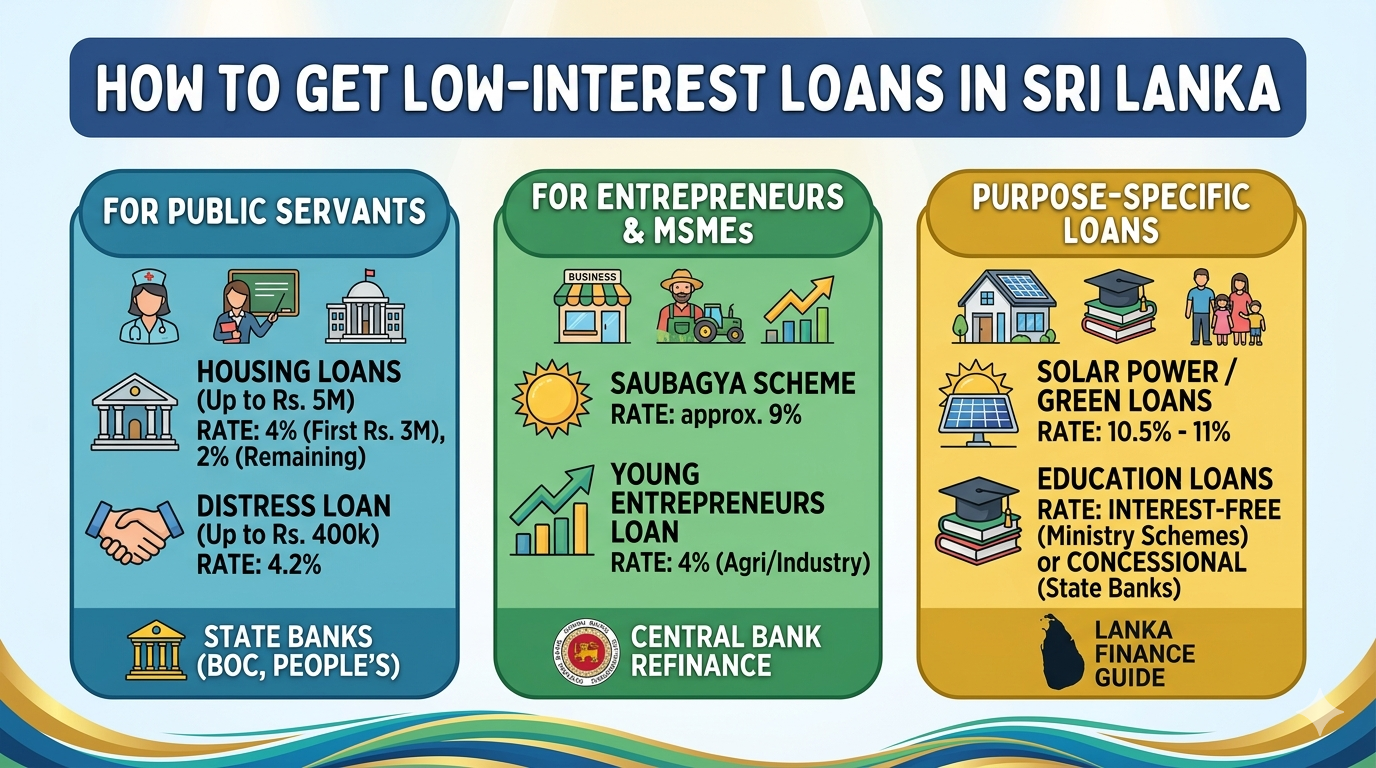
- The Structure: You can now obtain up to Rs. 5 million.
- The Rate: The first Rs. 3 million is usually charged at 4%, while the remaining amount can go as low as 2% under specific department grants.
- Where to Apply: Usually processed through Bank of Ceylon (BOC) or People’s Bank after approval from your respective Ministry.
Property and Distress Loans
Most government departments offer “Distress Loans” (Apada Naya). These are perfect for urgent needs. Currently, these are capped at around Rs. 400,000 with a nominal interest rate of 4.2%, which is significantly lower than any private bank’s personal loan.
3. Concessional Loans for MSMEs and Startups
For entrepreneurs running websites, gift services, or local shops, the government offers “Refinance Schemes.” If you are searching for how to get low-interest loans in Sri Lanka to grow a business, look for these:
- Saubagya (Prosperity) Loan Scheme: This program is designed for MSMEs in agriculture and manufacturing. Rates are typically capped at 9%.
- SME Empower: Offered by the State Mortgage & Investment Bank (SMIB), this scheme provides long-term capital for small businesses at rates lower than the standard 14-16% commercial average.
4. Best Private Bank Options for 2026
While state banks lead in subsidies, private banks like Sampath Bank, Commercial Bank, and HNB compete by offering “Green Loans” and “Educational Loans.”
- Solar Power Loans: To encourage renewable energy, many banks offer solar panel loans at 10.5% to 11%.
- Education Loans: If you are upgrading your qualifications (like moving from a diploma to a BSc), check for the interest-free student loan scheme provided by the government or specialized bank products that offer a grace period where you only pay the interest during your study years.
5. Step-by-Step: How to Get Low-Interest Loans in Sri Lanka
To ensure you get the best deal, follow this checklist:
Step 1: Clean Your CRIB Report
Every bank in Sri Lanka checks the Credit Information Bureau (CRIB). If you have late payments on credit cards or previous loans, banks will view you as “high risk” and charge higher interest. Ensure your report is clean before applying.
Step 2: Compare the “Effective” Rate
Don’t just look at the flat rate. Ask for a reduced balance rate. A 10% flat rate is often pricier than a 12% reducing balance rate over a long period.
Step 3: Check for Hidden Fees
Sometimes a “low-interest” loan comes with high management fees, insurance costs, or early settlement penalties. Always review the details carefully.
Step 4: Use Your Profession
Always mention your profession. Healthcare workers, engineers, and chartered accountants often have “Professional Loan” categories with discounted rates.
6. Comparison Table: Loan Rates in Sri Lanka (March 2026)
Loan Category | Low-Interest Source | Estimated Rate |
|---|---|---|
Housing (Govt.) | State Banks (BOC/People’s) | 2% – 4% |
Personal (Govt.) | Distress Loan | 4.2% |
Small Business | Saubagya Scheme | 9% |
Solar/Green | Commercial/Sampath | 10.5% |
Education | Ministry of Higher Ed | 0% (Interest-Free) |
Official Government Circulars (Highly Recommended)
Link these directly within the text when discussing the 4% Housing Loan and Distress Loans:
- Ministry of Public Administration (Circular 08/2026): This document is the definitive source for the new Rs. 5 million housing loan limit.
- Central Bank of Sri Lanka (Refinance Schemes): Use this document for the Saubagya and MSME loan sections.
2. State Banks (Application Portals)
Link these when explaining where to apply:
- Bank of Ceylon (BOC) Housing Loans: * Link: https://www.boc.lk/personal-banking/loans/housing-loan
- People’s Bank Suwasewana (For Health Sector): This loan is particularly relevant for your medical-focused audience.
3. Education & Specialized Loans
- Ministry of Higher Education (Interest-Free Loans): Essential if you mention BSc upgrades or student loans.
- Credit Information Bureau (CRIB): Link this page in the “Check your CRIB” section so users can see how to request their own report.
- Link: https://www.crib.lk/
Conclusion
Learning how to get low-interest loans in Sri Lanka requires a mix of patience and research. If you are a government employee, please consider exploring your departmental loan options first. For everyone else, state-backed MSME schemes are your best bet for keeping repayment costs low.
By maintaining a high credit score and choosing purpose-specific loans (like green or education loans), you can successfully navigate the financial landscape and secure the funding you need without the burden of high interest.
How to Get Low-Interest Loans in Sri Lanka , How to Get Low-Interest Loans in Sri Lanka